Guides
Hidden Analog Lines: A Building Audit Checklist
An analog-line inventory starts with three questions: What do you pay for? What does each line serve? What happens if it stops working?
The answers matter beyond desk phones. Fire panels, elevator phones, fax machines, gates and modems can all need attention during a copper migration. The FCC counted about 15 million retail switched-access lines as of June 30, 2025, down from about 27 million in June 2022. That measures connections, not your building's exposure. Your inventory needs to connect each billable number to its job.
Why analog lines hide
Use invoices as the starting point, then add the device and the person responsible for it. A number without a confirmed purpose remains an open question.
Southbound's audit-first approach looks for lines serving equipment that has already left. A missing label, an unanswered call or an unfamiliar invoice entry is a reason to investigate, never enough evidence to disconnect.
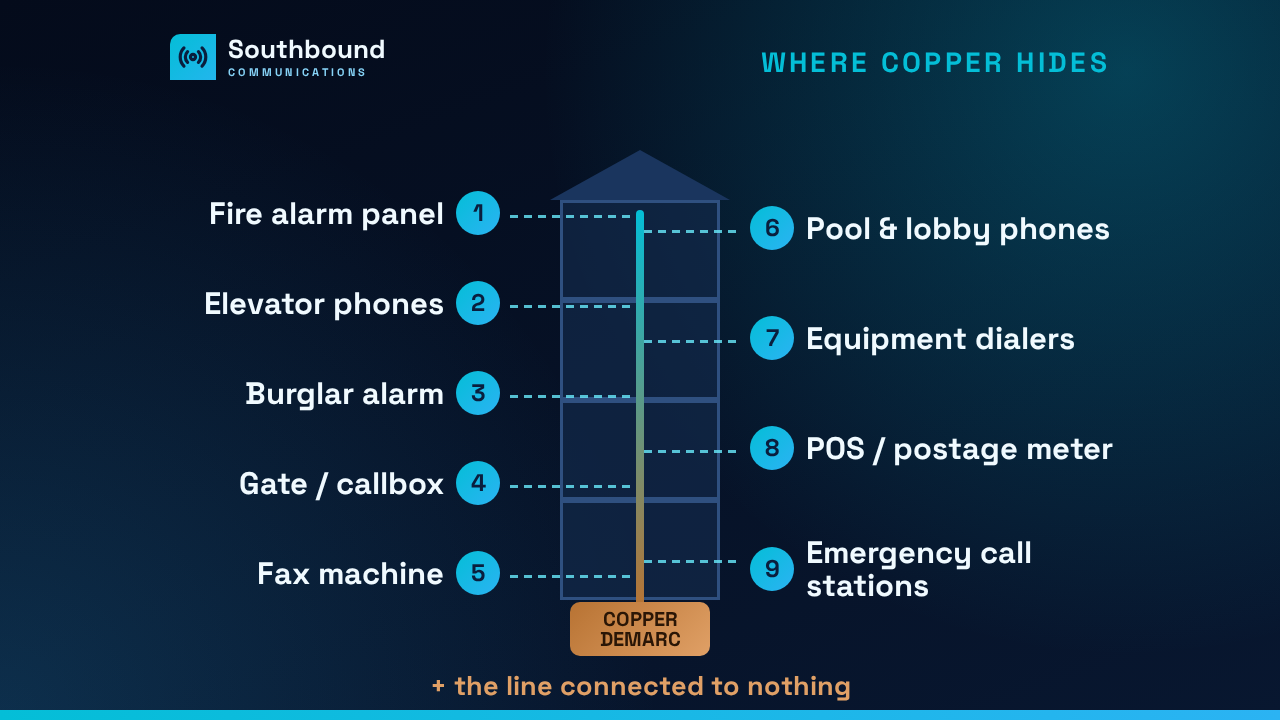
The 9 analog lines most buildings forget
Treat these as nine places to check, rather than nine lines every building has.
1. Fire alarm panel communicator
Record the communicator, monitoring company, transmission paths and secondary power. Reported NFPA 72 guidance says that, since the 2013 edition, two POTS lines are no longer recognized as a dual communication path. True dual path uses different technologies.
A single transmission path is permitted under Section 26.6.3.3 if supervised at intervals no longer than 60 minutes, with failure annunciated at the supervising station within 60 minutes, unless the AHJ or local code prohibits it.
The communicator must be UL 864 listed for its application. Fire alarm transmission paths effectively require about 24 hours of secondary power. An approximately eight-hour base battery, found in many managed cellular offerings, falls short of that requirement.
A successful dial-out alone cannot establish compliance. Document supervision, listing, power and the locally applicable requirements with the monitoring company and Authority Having Jurisdiction (AHJ).
2. Elevator emergency phones
Inventory each elevator's communication means. Under ASME A17.1, 2019 edition onward, two-way voice must reach a location staffed by authorized personnel. If unacknowledged within 45 seconds, the call must automatically route to an alternate location. Record location and car identification, visual acknowledgment and standby-power provisions for review.
3. Burglar and intrusion alarms
Keep these separate from fire alarm entries. Record the central station and the communication path it and the insurer accept.
4. Gates, door entry and callboxes
Check gate and callbox equipment against the invoice list. Record what each number does and who can confirm its operating requirements.
5. Fax machines
Fax needs its own migration assessment. Compressed cellular voice can damage modem tones. T.38 or G.711 handling can help, but successful operation still needs checking.
6. Pool, courtesy and lobby phones
Include these areas in the walkthrough if your property has them. Record any phone's purpose, destination and emergency-calling requirements before deciding its future.
7. Equipment alarm dialers
Ask whether equipment uses a modem or alarm dialer. Add confirmed connections to the inventory rather than assuming the office phone list covers them.
8. POS terminals, dial-up backups and postage meters
POS devices, modems and postage meters are among the most fragile migration cases. Assess each device individually rather than moving every analog connection onto the same path.
9. Emergency call stations
Include emergency call stations in the search. For any confirmed connection, document its purpose and response destination before planning a change.
Bonus: the line connected to nothing
A line serving retired equipment may be a cancellation candidate. Confirm its lack of dependencies first. Never use "nobody recognizes it" as the cancellation test.
How to run your own hidden-lines audit
1. Gather invoices for every location. Include all carriers and accounts, plus any discontinuance letters.
2. Build a line list. Record number, address, carrier, monthly charge, connected equipment and responsible contact. Mark unknowns explicitly.
3. Walk the building. Reconcile the list with fire, elevator, security, gate, fax and modem connections. Record evidence for each match.
4. Confirm device requirements. Review findings with the relevant monitoring company or service provider. Capture power, supervision and acceptance requirements before comparing migration options.
5. Separate priorities. Flag life-safety connections, business-critical devices and confirmed cancellation candidates. Keep unidentified lines open for investigation.
6. Match addresses to notices. A listed exchange does not establish that every address is affected. Compare your service and location with the carrier's notice and filing.
What to do with what you find
Let the device determine the path. Hosted voice or SIP can suit office calling. Fax requires attention to transmission handling. Fire panels need a listed communicator, supervision, adequate secondary power and AHJ acceptance. Elevator communications need their own code review and standby power.
Hosted voice is generally not appropriate for alarm panels or ring-down. A mixed migration plan may be appropriate, alongside carefully verified cancellations. Southbound compares paths after the inventory, without steering every line toward one replacement box.
Why this is urgent in Georgia
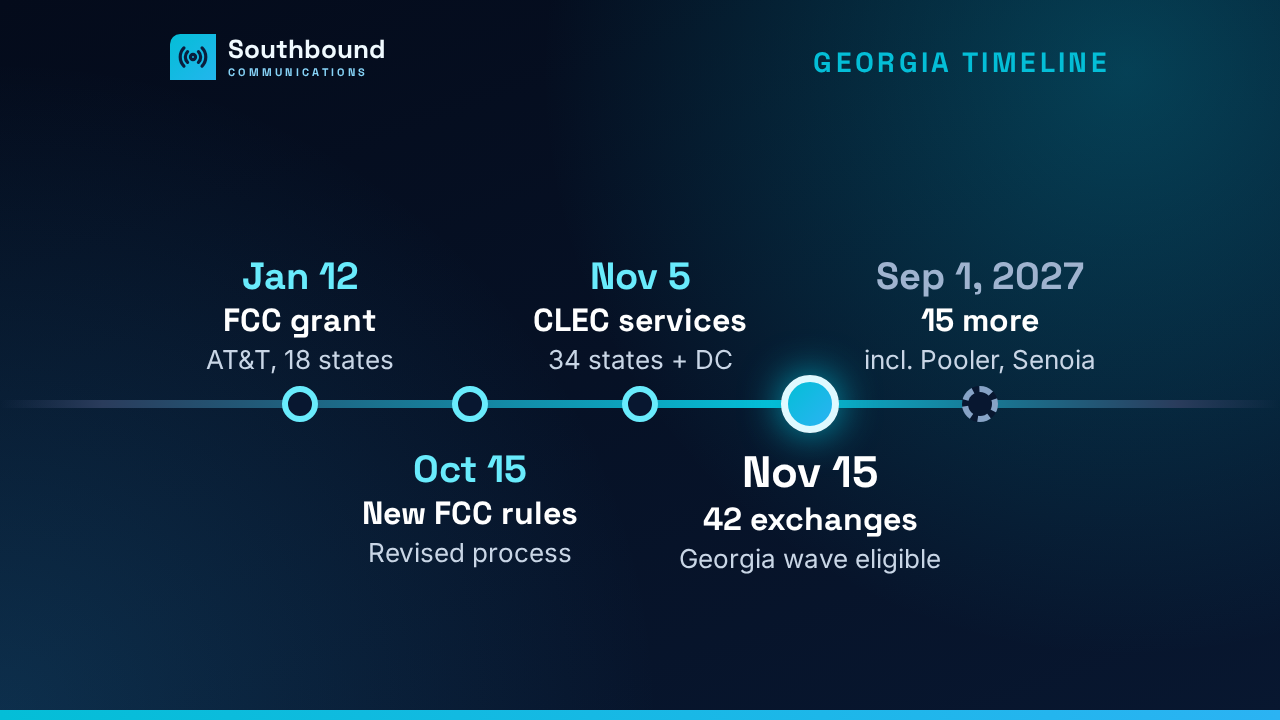
AT&T's second Georgia wave was authorized for discontinuance on or after November 15, 2026, across portions of 42 exchanges. That date has passed. It does not establish that every affected line has already stopped working.
AT&T's CLEC business local exchange service filing also included Georgia, with discontinuance on or after November 5, 2026. A further wave covering 15 Georgia exchanges passed its FCC automatic-grant date on October 22, 2026, for discontinuance on or after September 1, 2027.
There is no federal POTS shut-off date. Section 63.71 sets customer-notice content, without guaranteeing a fixed 90-day retail notice period. Carrier practice varies. Use the date in your carrier's notice to plan your work.
Frequently asked questions
What is a hidden analog line?
A billed line whose purpose is missing from your inventory. It may serve a fire panel, elevator, fax, gate or modem, or equipment that has been removed.
How do I identify an unknown line?
Match invoice numbers to equipment and confirm the connection with its service provider. Keep investigating until you can document its purpose or verify it is unused.
Does a fire panel dialing successfully prove compliance?
No. Review the communicator's listing, path supervision, secondary power and applicable local requirements. The AHJ decides whether the arrangement satisfies code at that site.
Do I have to replace every analog line?
No. Confirmed unused lines may be cancelled. Active lines need a plan based on their devices, operating requirements and carrier notices.
Get a free copper exposure audit
Southbound Communications is an Atlanta-based, vendor-neutral telecom advisor. We start with the inventory: what each line does, what it costs, which notices affect it and which lines may be cancelled.
Request your free copper exposure audit to build a migration plan around your actual equipment.
Sources
- FCC, Voice Telephone Services report, data as of June 30, 2025, released May 8, 2026.
- 47 CFR Section 63.71, customer notice and discontinuance procedures.
- NFPA 72, National Fire Alarm and Signaling Code, including Section 26.6.3.3. Dual-path interpretation above is reported, code-derived guidance; confirm the locally adopted edition with the AHJ.
- ASME A17.1, Safety Code for Elevators and Escalators, 2019 edition onward, Section 2.27.1.1 series.
- AT&T application, Florida PSC document 15393-2025, Exhibit 1, Georgia's 42 exchanges, discontinuance on or after November 15, 2026.
- FCC DA 26-1075, AT&T CLEC business local exchange service.
- FCC DA 26-1011, AT&T discontinuance on or after September 1, 2027.